Login
Login


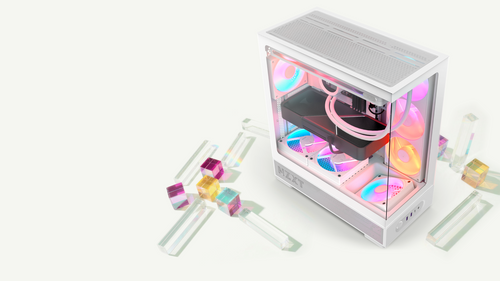
What is a dual-chamber PC case?

A dual-chamber PC case splits the interior into two compartments: a main chamber for the motherboard, CPU, graphics card and cooling, and a second chamber behind the motherboard tray for the power supply, drives and cables. The result is a cleaner main chamber, more room to route cables, and an unobstructed path for airflow.
If you're choosing between a dual-chamber case and a standard layout, the real question is how much width you can give up on your desk in exchange for space behind the motherboard. Here's how the two compare and who each one suits.
How is a dual-chamber case different from a standard case?
The difference is where the power supply and cables live. In a standard case, the PSU sits at the bottom under a shroud and cables run through a narrow gap behind the motherboard tray. In a dual-chamber case, the PSU, drives and most of the cabling move into a separate rear compartment.

That rear compartment makes a dual-chamber case wider than a standard case built for the same motherboard. In exchange, the bottom of the main chamber is free, which is why many dual-chamber designs use that space for bottom fans and take intake from the side instead of the front.
| Feature | Dual-chamber case | Standard case |
|---|---|---|
| PSU location | Rear chamber, behind the motherboard tray | Bottom of the main chamber, usually under a shroud |
| Cable routing space | Large: a full compartment | Smaller: a gap behind the motherboard tray |
| Footprint | Wider, often shorter in depth | Narrower |
| Typical intake | Side and bottom fans | Front fans |
| Main-chamber view | Uncluttered; PSU and drives hidden | Shroud and some cabling visible |
| Back-connect motherboards | Often supported thanks to the extra rear space | Depends on the case |
| Best for | Clean showcase builds, easier cable management | Smaller desks, straightforward front-to-back airflow |
What are the advantages of a dual-chamber case?
The main advantages are easier cable management and a cleaner main chamber. With the PSU and its cables in their own compartment, you have room to bundle and tie cables without forcing the side panel closed.

- More cable space. A whole compartment for cables is far more forgiving than a narrow gap, especially with a fully modular PSU and long GPU power cables.
- A clear view of the components you care about. The CPU cooler, memory and GPU sit in an open chamber with no PSU shroud in sight.
- Flexible fan placement. With the bottom of the main chamber free, many dual-chamber cases add bottom fan mounts that feed cool air straight to the GPU.
- Room for back-connect motherboards. Boards that move their power and header connectors to the rear need clearance behind the tray, and a rear chamber provides it.
What are the downsides of a dual-chamber case?
The main tradeoff is width. Moving the PSU behind the motherboard means the case has to be wider, so a dual-chamber case takes up more desk space side to side.

- Wider footprint. Measure your desk or the space under it before you buy.
- More planning for the PSU. Check the listed PSU length, and route cables with the rear chamber's airflow in mind.
- Different airflow logic. Side and bottom intake works well, but you need to plan which fans pull air in and which push it out rather than relying on a default front-to-back path.
Does a dual-chamber case cool better?
Not automatically. Cooling depends on fan count, fan placement and how freely air can enter and leave, not on the number of chambers. A well-configured standard case and a well-configured dual-chamber case can both cool a high-end build.
What a dual-chamber layout does give you is an uncluttered main chamber: no PSU and fewer cables sitting in the airflow path. Pair that with a sensible intake and exhaust plan, such as side or bottom intake with top and rear exhaust, and the layout works in your favor.
Who should pick a dual-chamber case, and who should pick a standard layout?
Pick a dual-chamber case if you value cable management and a clean view and have the desk width for it. Pick a standard layout if you want a narrower footprint or prefer a simple front-to-back airflow path.
- Choose dual-chamber if: you're building a showcase PC, using a back-connect motherboard, running a lot of cables, or you want bottom fans feeding the GPU.
- Choose a standard layout if: desk width is tight, you want front-mounted radiator support, or you prefer the most familiar build process.
Which NZXT cases fit each layout?
To see the tradeoff in real numbers, compare the listed specs of two mid-towers.

- H6 is listed as a dual-chamber ATX case with up to 90 mm of cable routing space, back-connect motherboard support (ATX), and three 120 mm front-right fan mounts. It's 292 mm wide. View product
- H5 Flow takes intake through front fan mounts, supports a front radiator up to 360 mm, and lists up to 28.7 mm of cable routing space. It's 225 mm wide. View product
The H6 is 67 mm wider and has more than three times the cable routing space. That's the dual-chamber tradeoff in two numbers. Browse every layout in PC cases.
Quick checklist
- Measure your desk width and depth, and compare them with the case's listed dimensions.
- Decide whether cable management and a clean main chamber are worth extra width.
- Check GPU length clearance with your planned side or front fans installed.
- Confirm PSU length support and plan how cables will route through the rear chamber.
- If you're using a back-connect motherboard, confirm the case lists support for it.
- Plan intake and exhaust before you buy fans: which mounts pull air in, which push it out.
FAQ
Is a dual-chamber case good for beginners?
Yes. The extra cable space is forgiving, so you don't have to route every cable perfectly to close the side panel. Just plan your fan directions ahead of time, because airflow doesn't follow the usual front-to-back path.
Is a dual-chamber case bigger than a normal case?
It's usually wider, because the PSU and cables sit behind the motherboard tray instead of underneath it. Depth and height can be similar to or smaller than a standard mid-tower, so compare all three listed dimensions.
Do dual-chamber cases have worse GPU temperatures?
Not inherently. Many dual-chamber cases add bottom fan mounts that blow fresh air directly at the GPU. GPU temperatures depend on how much cool air reaches the card, so set up bottom or side intake.
Can I use any power supply in a dual-chamber case?
Most dual-chamber mid-towers take standard ATX power supplies, but rear-chamber space is finite. Check the case's maximum PSU length, and remember that a fully modular PSU makes the rear chamber easier to keep tidy.
Do I need a back-connect motherboard for a dual-chamber case?
No. Standard motherboards work fine. Back-connect boards are an option in cases that list support for them, and they move the connectors to the rear chamber for an even cleaner front view.