Logga in
Artikel: Where Should You Mount an AIO Radiator? Top, Front, or Bottom
Where Should You Mount an AIO Radiator? Top, Front, or Bottom

Short answer: Mount the radiator in the top of your case with the fans set as exhaust. If your case cannot fit your radiator up top, the front is the next best spot. Do not bottom-mount an AIO. The rule that matters more than any of this: the highest point of the radiator should always sit above the pump cap.
Radiator placement is one of the few build decisions that affects how long your cooler lasts, not just how cool it runs. Get it wrong and air collects in the pump, which is where the gurgling noises and the early failures come from. Here is how to think about it.
The one rule that decides everything: keep the radiator above the pump
Every AIO liquid cooler ships with a small amount of air in the loop on purpose. It gives the coolant somewhere to expand into as the system heats up and cools down. That air has to live somewhere, and you want it living in the radiator.
If the pump ends up as the highest point in the loop, air migrates into the pump housing and stays there. A pump running on air instead of liquid moves less heat, makes more noise, and wears out faster. So whatever mounting position you choose, check the same thing: is the top of the radiator higher than the pump cap on your CPU? If yes, you are fine. If no, move it.
Top mounting: the default answer
If your case supports a top mount for your radiator size, take it. Two reasons:
- The radiator sits above the pump by a comfortable margin, so trapped air has nowhere to go but up and away from the pump.
- Heat from the coolant leaves the case immediately instead of being pushed across your other components.
Set the fans to exhaust, pushing air up through the radiator and out of the case. This is the configuration NZXT recommends for top-mounted Kraken coolers. If you are fitting the cooler from scratch, our step-by-step guide to installing an AIO liquid cooler covers the rest of the install.
Case support varies, and it varies per position, which is the part people miss. Across the current range: the H9 Flow takes up to 420mm in the top and 420mm on the front-right; the H7 Flow takes 360mm in the top and 420mm in the front; the H6 and H6 Flow take 360mm in the top; the H5 Flow takes 240mm in the top and 360mm in the front; the H3 Flow takes 240mm in the top and 280mm in the front; and the H2 Flow takes 280mm in the front. Check the radiator support list for your specific case before you buy a cooler, because a 360mm radiator in a case rated for 280mm is a returned order.
Front mounting: the good alternative
If the top of your case will not take your radiator, mount it in the front. NZXT refers to this as a side mount, and it is a genuinely fine option rather than a consolation prize. Plenty of cases fit a larger radiator in the front than they do in the top, so front mounting can actually get you more cooling surface.
The one thing to verify is still the pump rule. In most mid-tower cases a front-mounted radiator sits well above the CPU socket, so you are covered. In a compact or ITX build, measure it rather than assuming.
Should the tubes go at the top or the bottom?
This is the most argued-about question in AIO installs and the honest answer is that it comes down to preference. Tubes at the bottom can be quieter, because you are less likely to hear a trickling sound from coolant moving through the radiator. Tubes at the bottom is also easier to route in a lot of cases. Neither orientation will meaningfully change your temperatures.
Pick the one that makes your cable routing cleaner and stop worrying about it.
Why you should not bottom-mount an AIO
Bottom mounting puts the radiator below the pump, which is exactly the situation the pump rule exists to prevent. Air in the loop collects at the highest point, and if that point is your pump cap, the pump is running on air.
The symptoms show up as a bubbling or rattling noise from the cooler, higher CPU temperatures than the cooler should deliver, and a shorter pump life. It is not an instant failure, which is why people get away with it for a while and then post about it six months later. NZXT does not recommend bottom-mounting a Kraken radiator in any configuration.
Does radiator position actually change my temperatures?
Less than most people expect. Radiator size and fan setup drive cooling performance far more than whether the radiator is in the top or the front. A 360mm radiator in the front will outperform a 240mm in the top. Adding a second set of fans is a separate question, covered in whether a push-pull radiator setup is worth it.
Where position genuinely matters is airflow direction and longevity. A top-mounted exhaust radiator dumps CPU heat straight out of the case instead of feeding it to your GPU. And correct positioning relative to the pump is what keeps the cooler healthy over years, not weeks.
Quick reference
| Position | Recommended | Fan direction | Watch out for |
|---|---|---|---|
| Top | Yes, first choice | Exhaust | Clearance between radiator and motherboard components |
| Front / side | Yes, good alternative | Intake or exhaust | Confirm the radiator still sits above the pump |
| Rear | Only for small radiators | Exhaust | Usually limited to 120mm or 140mm |
| Bottom | No | n/a | Air collects in the pump, causing noise and early wear |
Frequently asked questions
Can I mount my AIO radiator in the front as intake?
Yes. Front intake pulls cooler outside air across the radiator, which is good for CPU temperatures, though it does raise the temperature of the air reaching the rest of your components slightly. Front exhaust does the opposite. Either works, and the difference is small in a case with reasonable airflow.
What happens if the pump is higher than the radiator?
Air in the loop collects in the pump. Expect a bubbling or gurgling noise, reduced cooling performance, and a shorter pump lifespan. If you have already built it this way, remount the radiator higher rather than living with it.
My AIO is mounted correctly but still makes noise. What now?
Air can still work its way into the pump even in a correct install. It is usually fixable at home by releasing the pump cap and shaking it to move the air back into the radiator. Our full walkthrough is in why your AIO is making a gurgling or rattling noise.
Does tube orientation affect cooling performance?
No. It can affect noise slightly, with tubes at the bottom generally being quieter, but it does not change thermal performance in any way you would notice.
How do I know which radiator sizes my case supports?
Check the specifications for your case model. Radiator support is listed per mounting position, so a case may support 360mm in the front and only 240mm in the top. NZXT lists this on every case product page and in the manual.
Still stuck?
Our support team handles this every day. Head to NZXT Support and we will help you work out the right position for your case and cooler combination.
If it will not fit where you want it

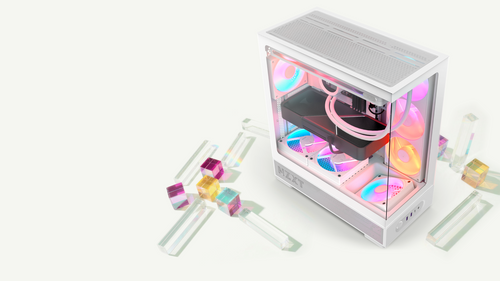
H9 Flow
420mm support at the top and at the front-right, so the radiator goes where the airflow makes sense instead of wherever it happens to clear.
See the H9 FlowExplore the lineup: Kraken AIO coolers and NZXT case fans.